
Beyond Burn-Through Point: Building a Hybrid Level-2 Intelligence Layer for Iron Ore Sintering
How first-principles models, dynamic state estimation and machine learning can turn a sinter plant from reactive operation into predictive process control.
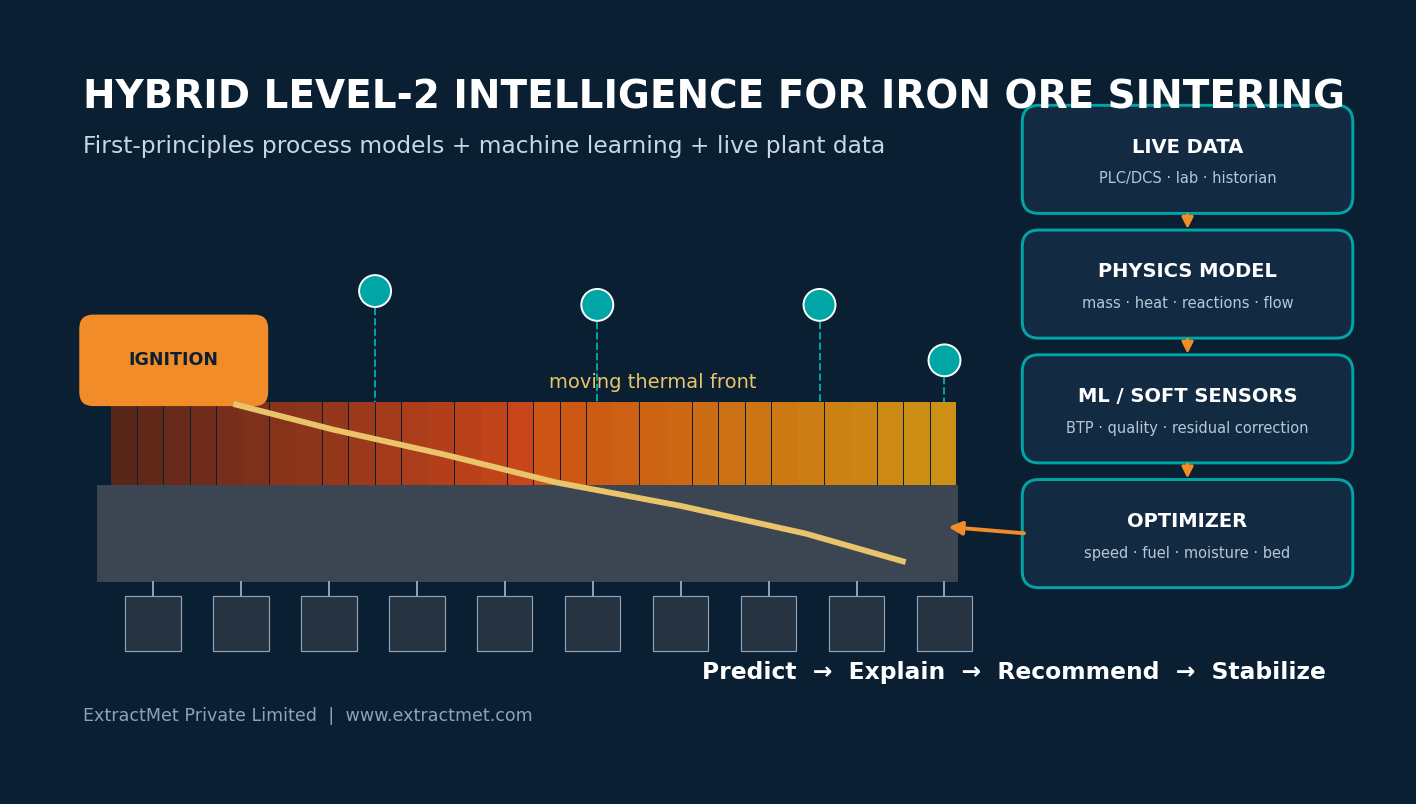
In an integrated steel plant, the sinter plant sits upstream of the blast furnace—but its operating variability is felt far downstream. Ore-fines chemistry changes. Coke breeze quality changes. Return fines fluctuate. Moisture, granulation, permeability, bed height, suction and ignition conditions move together. The thermal front develops inside a porous bed that cannot be fully instrumented, while the operator must still deliver stable productivity, fuel rate, sinter chemistry, strength and size distribution.
That makes iron ore sintering a natural candidate for a Level-2 process intelligence layer: a system that sits above conventional Level-1 automation, continuously reconstructs the process state, predicts what is likely to happen next, and recommends operating actions before quality or productivity drifts become visible at the discharge end.
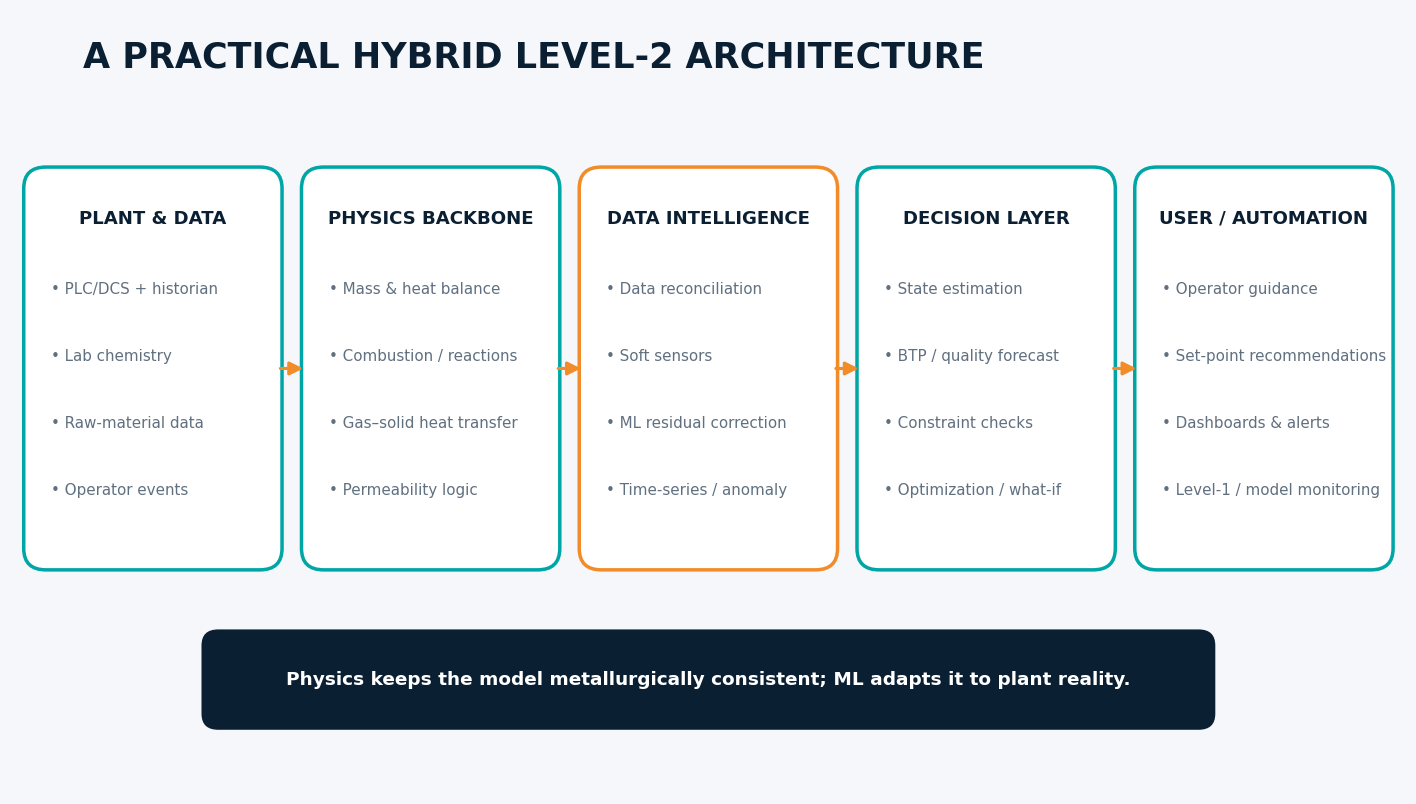
At ExtractMet Private Limited, our proposed approach is deliberately hybrid: use first-principles metallurgy and process engineering as the calculation backbone, then use machine learning and plant data to adapt, correct and accelerate the model. The goal is not another dashboard. The goal is a plant-specific decision-support system that can be audited by process engineers and trusted by operators.
Why sintering is difficult to control
A travelling-grate sinter machine is a strongly coupled, nonlinear process. The feed recipe influences granulation; granulation influences bed permeability; permeability influences gas flow; gas flow changes the temperature profile and flame-front velocity; thermal history influences melt formation, bonding phases, FeO, strength, yield and return fines. Meanwhile, strand speed determines residence time and therefore where the burn-through point occurs.
Several important process states are also not measured directly. Burn-through point (BTP), flame-front position, local melt fraction, bed permeability and many quality indicators are inferred from delayed or indirect measurements. This is exactly the situation where a Level-2 model is valuable: it creates a continuously updated “best estimate” of the hidden process state.
Published industrial work has shown that thermal-state and BTP-based intelligent control can be implemented on real sinter machines, while current OEM automation portfolios increasingly combine predictive models, closed-loop control, AI and digital-twin concepts for sinter optimization. The direction of travel is clear: sintering is moving from measurement and alarm systems toward prediction and supervisory optimization.
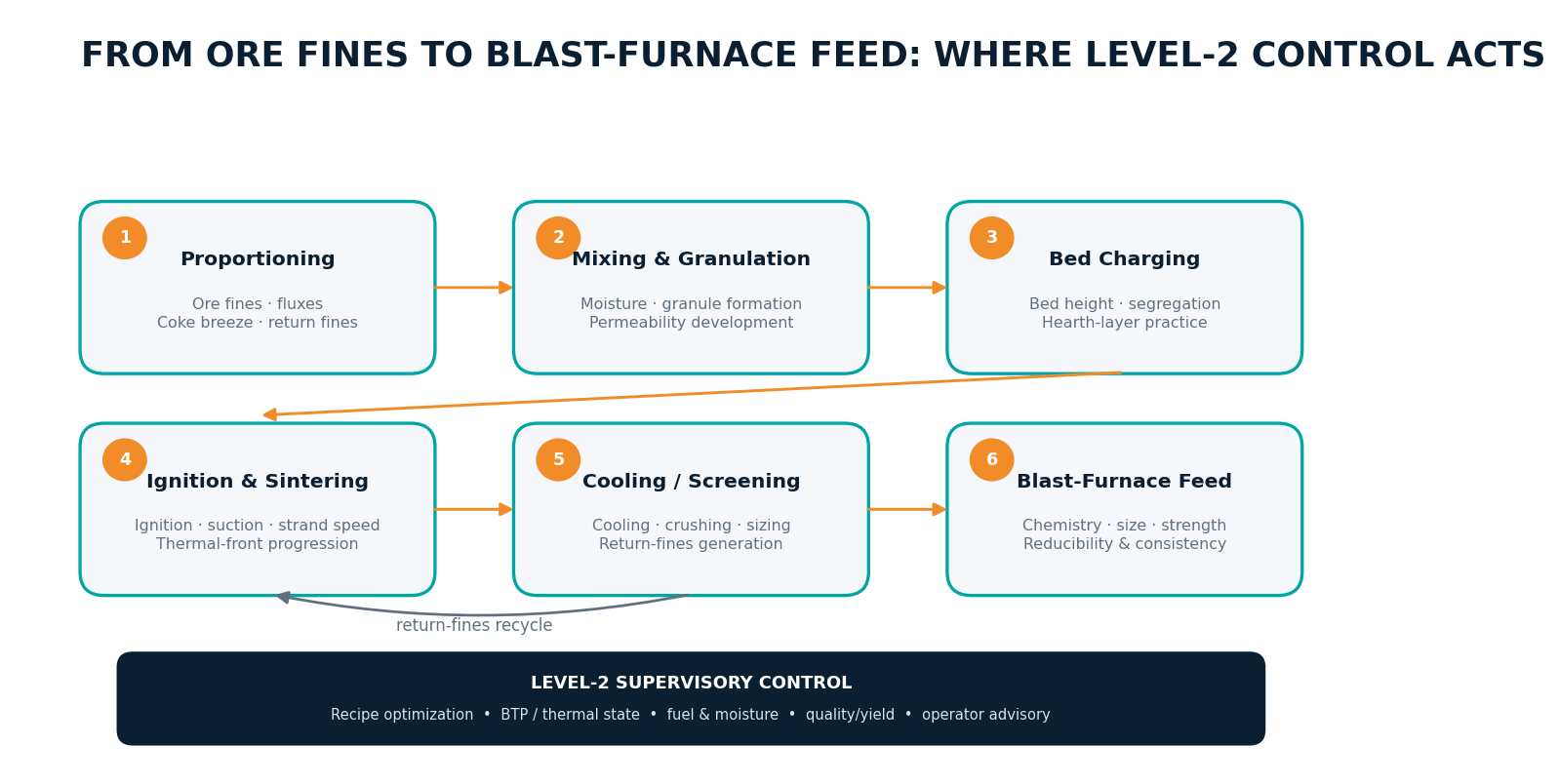
What Level-2 should add above Level-1
Level-1 automation is essential for reliable execution: drives, feeders, valves, ignition systems, pressure control loops, interlocks and basic regulatory control. A Level-2 system should not duplicate those functions. It should answer a different set of questions:
- What is the current metallurgical and thermal state of the bed?
- Where is the burn-through point likely to occur if nothing is changed?
- Is a change in windbox temperature caused by ore blend, moisture, permeability, suction, fuel, or speed?
- What operating adjustment is most likely to recover stability with minimum penalty?
- What sinter quality, productivity, fuel rate and return-fines level are likely from the current operating trajectory?
- Are we still inside the validated operating envelope of the model?
A useful Level-2 solution therefore combines estimation, prediction, optimization and explanation—not just visualization.
The static model: the metallurgical baseline
The first layer is a static process model. It represents the plant at a defined operating condition and provides the mass, elemental and energy framework against which dynamic behavior can be interpreted.
A plant-specific static sinter model can include:
- iron ore fines, coke breeze, return fines, limestone, dolomite, quicklime and other fluxes;
- ore and flux chemistry, loss on ignition and size distribution;
- target sinter basicity and chemical constraints;
- moisture and granulation assumptions;
- coke/fuel requirement and combustion balance;
- carbonate decomposition and major heat effects;
- gas requirement, waste-gas generation and heat losses;
- expected sinter production, yield, return-fines recycle and specific energy/fuel indicators;
- estimated quality proxies such as FeO, chemistry consistency and selected strength/reducibility relationships when sufficient plant data exist.
The static model is especially useful for recipe design, raw-material substitution studies, what-if analysis and baseline optimization. Because its balances are explicit, engineers can inspect why a recommendation changed when ore chemistry, return fines, fuel quality or flux availability changes.
The dynamic model: seeing the process before the discharge end
The dynamic layer adds time and position. It should reconstruct how the sinter bed evolves as the pallet travels from ignition to discharge.
Depending on instrumentation and project scope, the dynamic model can estimate or predict:
- moisture drying and the movement of the drying/condensation zones;
- coke combustion and heat-release progression;
- gas–solid heat transfer and bed thermal history;
- flame-front or thermal-front velocity;
- windbox temperature profile and characteristic thermal points;
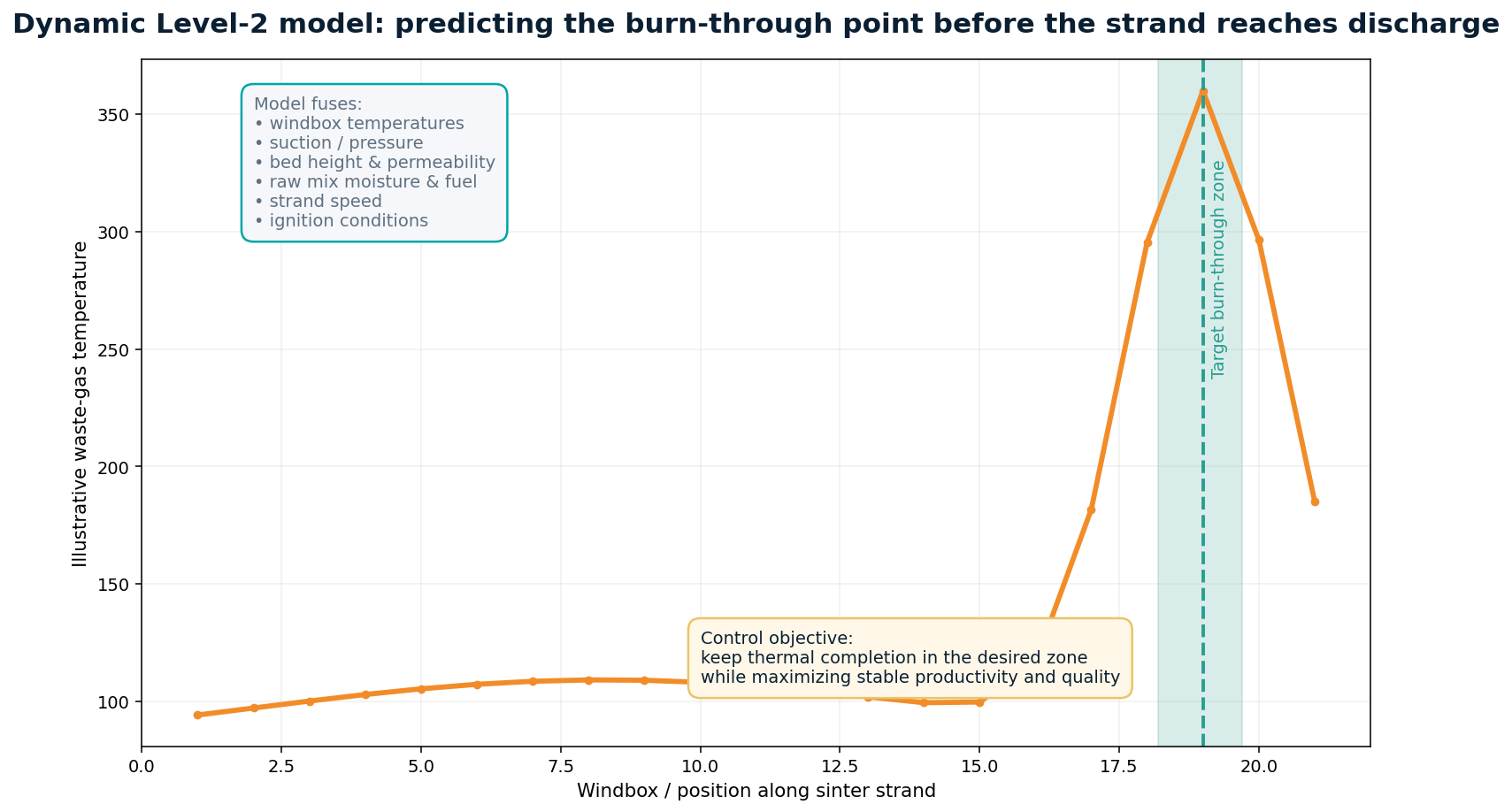
- predicted BTP location and burn-through time;
- permeability or resistance proxies from suction, pressure drop, flow and bed conditions;
- process response to strand-speed, bed-height, moisture, fuel and ignition changes;
- abnormal thermal behavior, air leakage signatures and drift from the normal operating envelope.
The most useful output is not merely “BTP = windbox 19.” It is a forward prediction: where BTP is heading, how confident the model is, what variables are driving the shift, and which feasible control action can bring it back toward the preferred zone.
Why hybrid physics + machine learning is stronger than either alone
Pure first-principles models are transparent, but industrial sintering includes uncertain permeability, nonuniform granulation, changing raw-material characteristics, heat losses, leakage and plant-specific empirical behavior that are difficult to represent perfectly.
Pure machine-learning models can be highly accurate inside the data distribution, but they may struggle when the ore blend, fuel, equipment condition or operating practice changes beyond what the training data have seen. They can also be difficult for process engineers to audit if the model has no metallurgical structure.
A hybrid model uses each method where it is strongest:
Physics provides the backbone. Conservation of mass and energy, chemistry, reaction heat, gas flow relationships and known metallurgical constraints prevent impossible predictions.
Machine learning provides adaptation. ML can learn residual corrections, soft-sensor relationships, nonlinear quality mappings, time-series behavior and plant-specific bias that the mechanistic model does not fully capture.
State estimation reconciles both. Live measurements continuously update uncertain model states and parameters so that the digital representation remains aligned with the physical plant.
The result is a Level-2 system that is both interpretable and adaptive.
A practical data map for a sinter Level-2 solution
A typical implementation can ingest data from several existing sources rather than requiring a completely new instrumentation architecture.
Raw-material and laboratory data: ore and flux chemistry, coke-breeze properties, return-fines rate, size distributions, moisture, sinter chemistry and quality tests.
Process data: feeder rates, mix moisture, mixer/granulator operation, bed height, strand speed, ignition settings, hood temperature, windbox temperatures, suction pressure, main-exhauster data, off-gas measurements, cooler data and production rate.
Context and event data: blend changes, maintenance events, screen/crusher status, known leakage events, operator actions, downtime and campaign identifiers.
The Level-2 platform should time-align these data, validate tags, identify bad sensors, reconcile material flows and create a consistent feature/state set before models are used for control recommendations. In practice, data engineering is not a side activity—it is part of the metallurgical model.
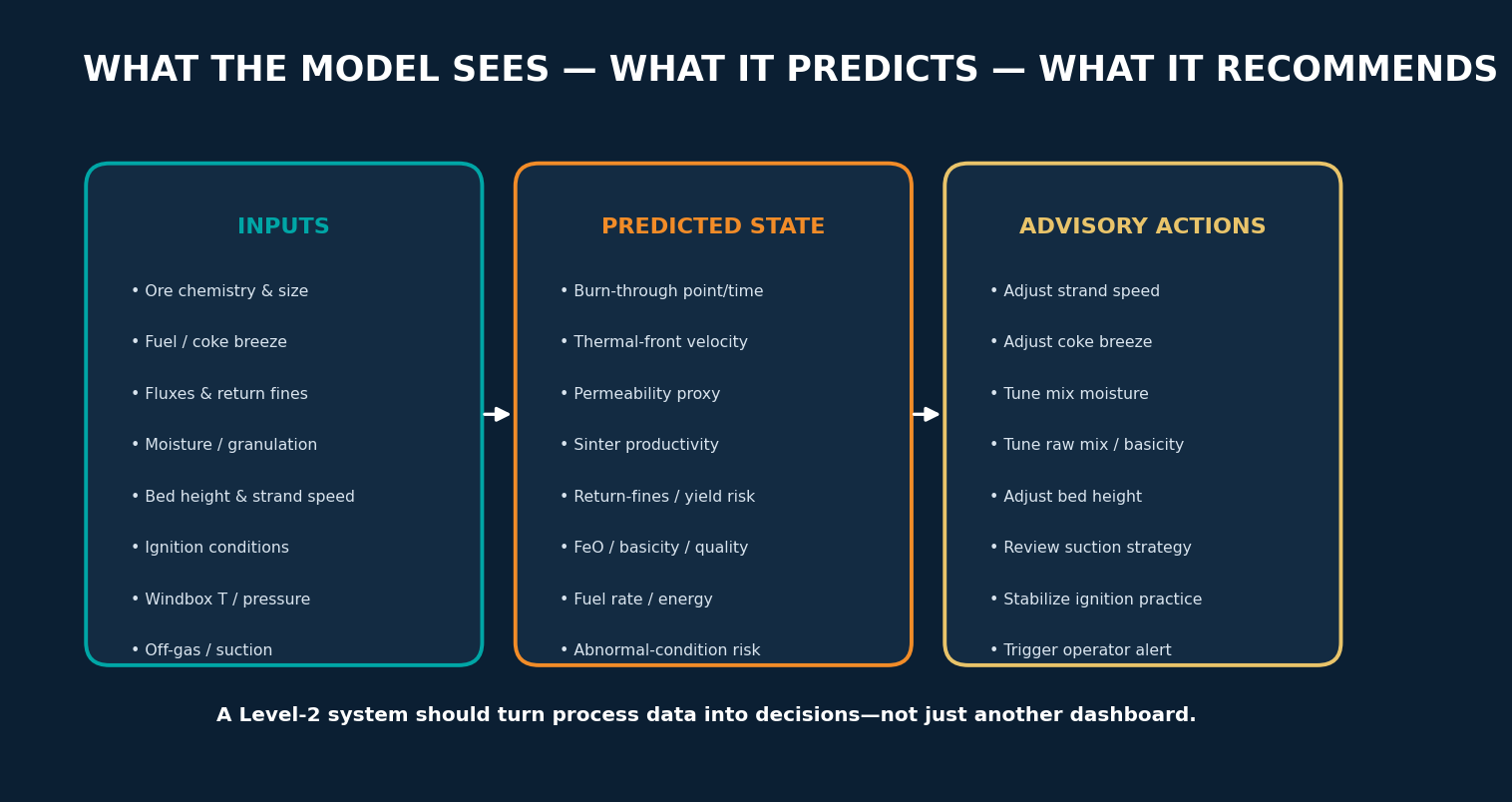
What operators and process engineers could receive
A well-designed advisory screen should be concise. Operators do not need fifty model outputs; they need the few variables that support the next decision.
Examples include:
- Predicted BTP: current estimate, 5–15 minute forecast and target zone.
- Thermal-state index: whether the bed is trending cold, normal or hot.
- Permeability indicator: current resistance relative to normal practice.
- Speed recommendation: maintain / increase / decrease, with a recommended range and reason.
- Fuel recommendation: expected effect of coke-breeze change on BTP, fuel rate and quality.
- Moisture recommendation: expected effect on granulation/permeability and thermal progression.
- Quality forecast: expected FeO/basicity or plant-selected quality KPI, with confidence range.
- Return-fines/yield risk: early warning of operating conditions associated with poor screen yield.
- Abnormal-condition alert: sensor inconsistency, leakage signature, unusual thermal profile or out-of-envelope input.
Crucially, every recommendation should be traceable: what changed, what the model predicts, why it recommends an action, and what trade-off is expected.
Where the business value can emerge
The economic case for Level-2 control does not depend on one spectacular optimization. It usually comes from removing repeated small losses and reducing variability shift after shift.
Potential value areas include:
- more stable sinter chemistry and thermal condition;
- improved strand productivity at an acceptable burn-through margin;
- lower or more stable coke-breeze consumption;
- reduced return-fines generation and improved usable sinter yield;
- more consistent bed permeability through moisture and granulation guidance;
- faster response to raw-material changes;
- reduced dependence on operator-specific heuristics;
- better traceability for root-cause analysis and continuous improvement;
- integration of energy and emissions KPIs into operating decisions;
- stronger upstream stability for blast-furnace burden quality.
The correct KPI set is plant specific. That is why the best starting point is often one high-value decision problem—for example BTP stability or specific fuel consumption—rather than attempting full autonomous control on day one.
How ExtractMet would approach a plant-specific project
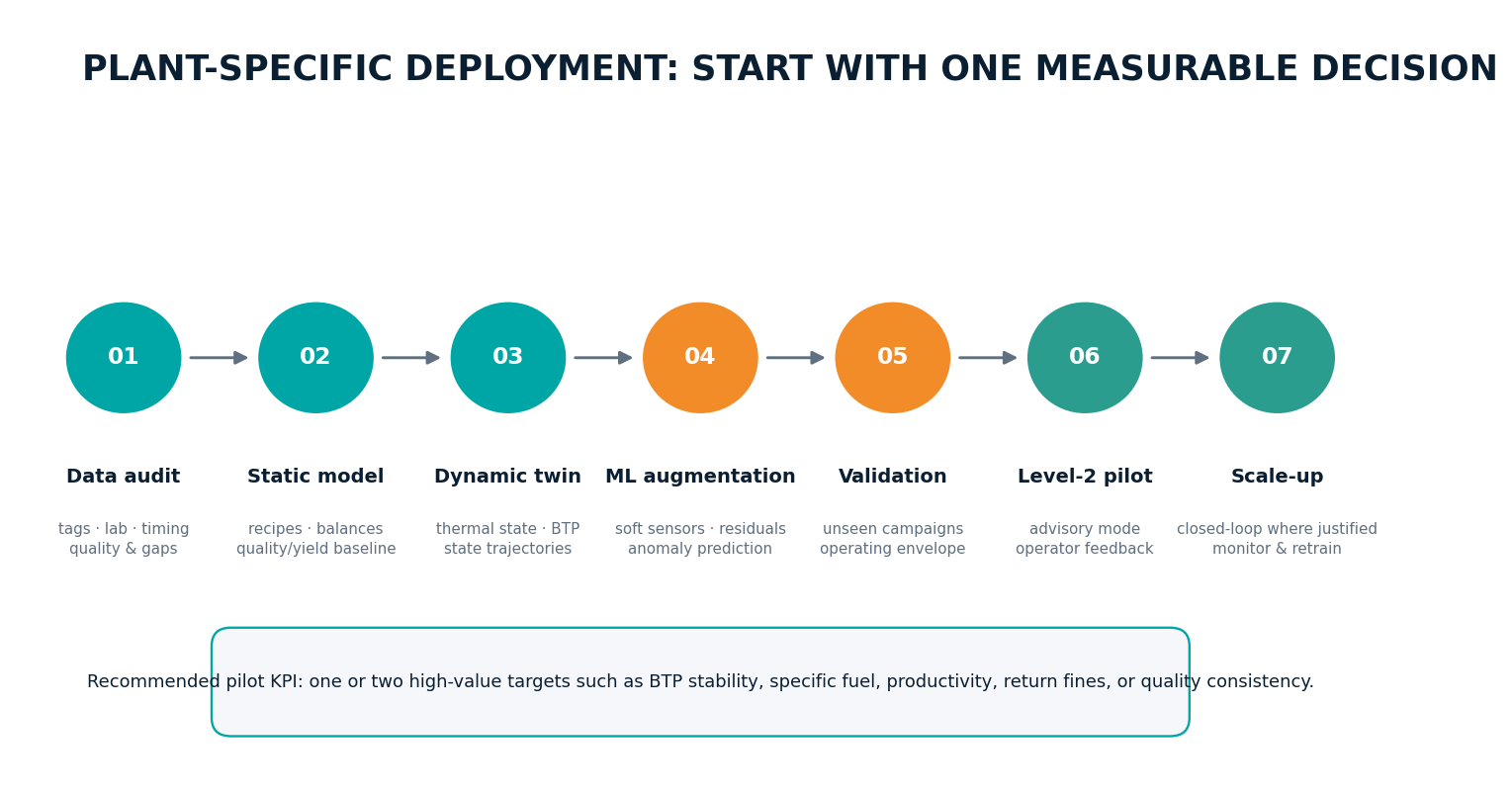
ExtractMet’s broader digital-twin methodology begins with first-principles balances, thermodynamics, kinetics and plant data, and can be scaled from an offline engineering model to an operator-advisory or Level-2 system. For a sinter plant, a practical project could proceed in seven stages:
- Data and instrumentation audit — map available tags, lab data, sampling delays, quality KPIs and data gaps.
- Static model development — establish the raw-mix, mass/heat balance, fuel and quality baseline.
- Dynamic thermal/BTP model — build the time/position-resolved process-state estimator.
- Machine-learning augmentation — develop soft sensors, residual corrections, anomaly models and quality predictors where data support them.
- Historical validation — test unseen campaigns, ore blends, operating rates and abnormal conditions.
- Advisory Level-2 pilot — run recommendations in parallel with the operators and measure agreed KPIs.
- Integration and scale-up — connect to historian/LIMS/automation systems and, only where justified and approved, progress toward closed-loop supervisory control.
This incremental path lowers implementation risk and creates evidence for investment decisions.
The opportunity
The sinter plant is too important to be controlled only by delayed laboratory results, isolated control loops and operator memory. The process already generates a large amount of useful information. The missing layer is often the metallurgical intelligence that connects those signals to the hidden state of the bed and to the decisions that matter.
A hybrid Level-2 system can provide that connection: physics to keep the model grounded, machine learning to capture plant-specific behavior, and real-time data to keep the model synchronized with operations.
If your plant is facing unstable burn-through, variable return fines, high coke-breeze consumption, changing ore blends, inconsistent productivity or a need to modernize sinter-plant automation, ExtractMet can develop a plant-specific static + dynamic process-control model and define a practical path toward Level-2 advisory control and digital-twin deployment.
Discuss a sinter-plant modelling or Level-2 pilot with ExtractMet: https://www.extractmet.com/
Explore our Digital Twin Portfolio: https://www.extractmet.com/digital-twins.html">https://www.extractmet.com/digital-twins.html
Explore the Model Demo Hub: https://www.extractmet.com/Models.html">https://www.extractmet.com/Models.html
Start with one measurable decision problem and validate it against your historical operating data. Discuss a project with ExtractMet.