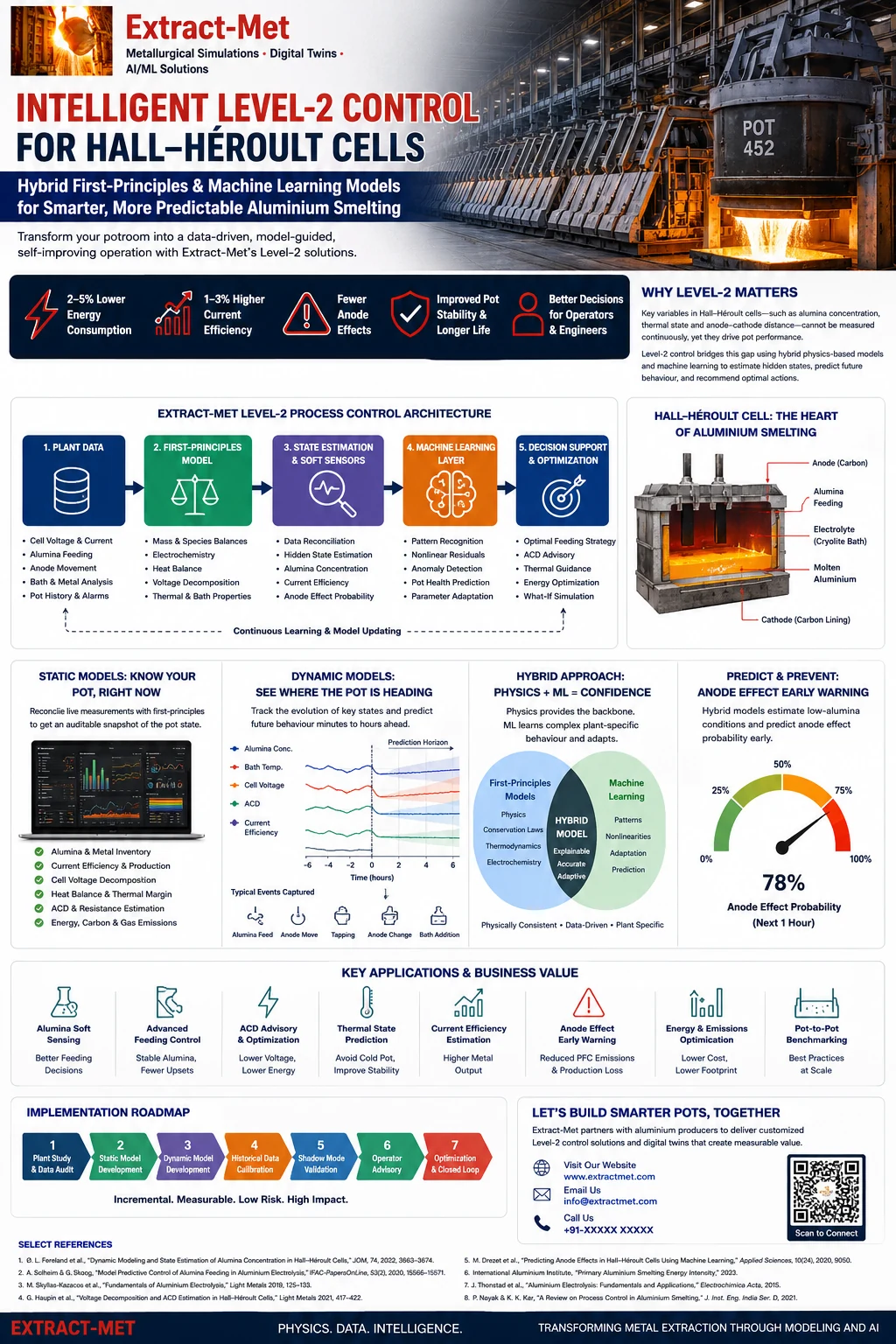
Metallurgical Process Modelling · Digital Twins · AI/ML Solutions
The Hall–Héroult Pot Is Already Data-Rich. What It Needs Next Is Process Intelligence.
A hybrid Level‑2 control framework for aluminium smelting—combining first-principles metallurgy, dynamic state estimation and machine learning to make each reduction cell more observable, predictive and actionable.
By Extract‑Met | Metallurgical Process Modelling • Digital Twins • AI/ML Solutions
Primary aluminium smelting has never lacked process data. Modern Hall–Héroult potlines continuously generate cell voltage, line current, feeder events, anode movements, tapping records, alarms and historian trends.
The real challenge is different:
How do we turn those signals into a reliable estimate of what is actually happening inside the pot—and then predict what should be done next?
This matters because several states that strongly influence pot performance are difficult to measure continuously: dissolved alumina concentration, local alumina distribution, evolving thermal condition, anode–cathode distance (ACD), resistance contributions, current efficiency and the onset of abnormal conditions.
That is where a modern Level‑2 process-control layer can create value.
At Extract‑Met, our proposed philosophy is deliberately hybrid:
Use physics to make the model trustworthy. Use plant data to make it specific. Use machine learning to make it adaptive. Use optimization to make it actionable.
Why Hall–Héroult control is an ideal Level‑2 problem
The Hall–Héroult cell is simultaneously an electrochemical reactor, a high-current electrical system, a thermal system, a multiphase transport system and a continuously disturbed production unit.
Every operating action interacts with several others.
Feed alumina and the local concentration changes only after transport and dissolution.
Move the anodes and cell resistance changes, but the thermal and magnetohydrodynamic consequences may develop over a different timescale.
Tap metal and the bath/metal geometry changes.
Replace an anode and the current distribution, local heat generation and gas evolution respond.
Change line current and the effect propagates simultaneously through aluminium production, heat generation, thermal balance, voltage and stability.
The process is therefore multivariable, nonlinear, dynamic and only partly observable.
The International Aluminium Institute tracks smelting energy intensity specifically because electrolysis power is central to primary aluminium economics. For a plant, even modest changes in specific energy, current efficiency, anode-effect frequency, metal production or pot stability can become important when multiplied across hundreds of cells and thousands of operating hours.
This is precisely the type of process where a Level‑2 model should sit between raw automation data and operating decisions.
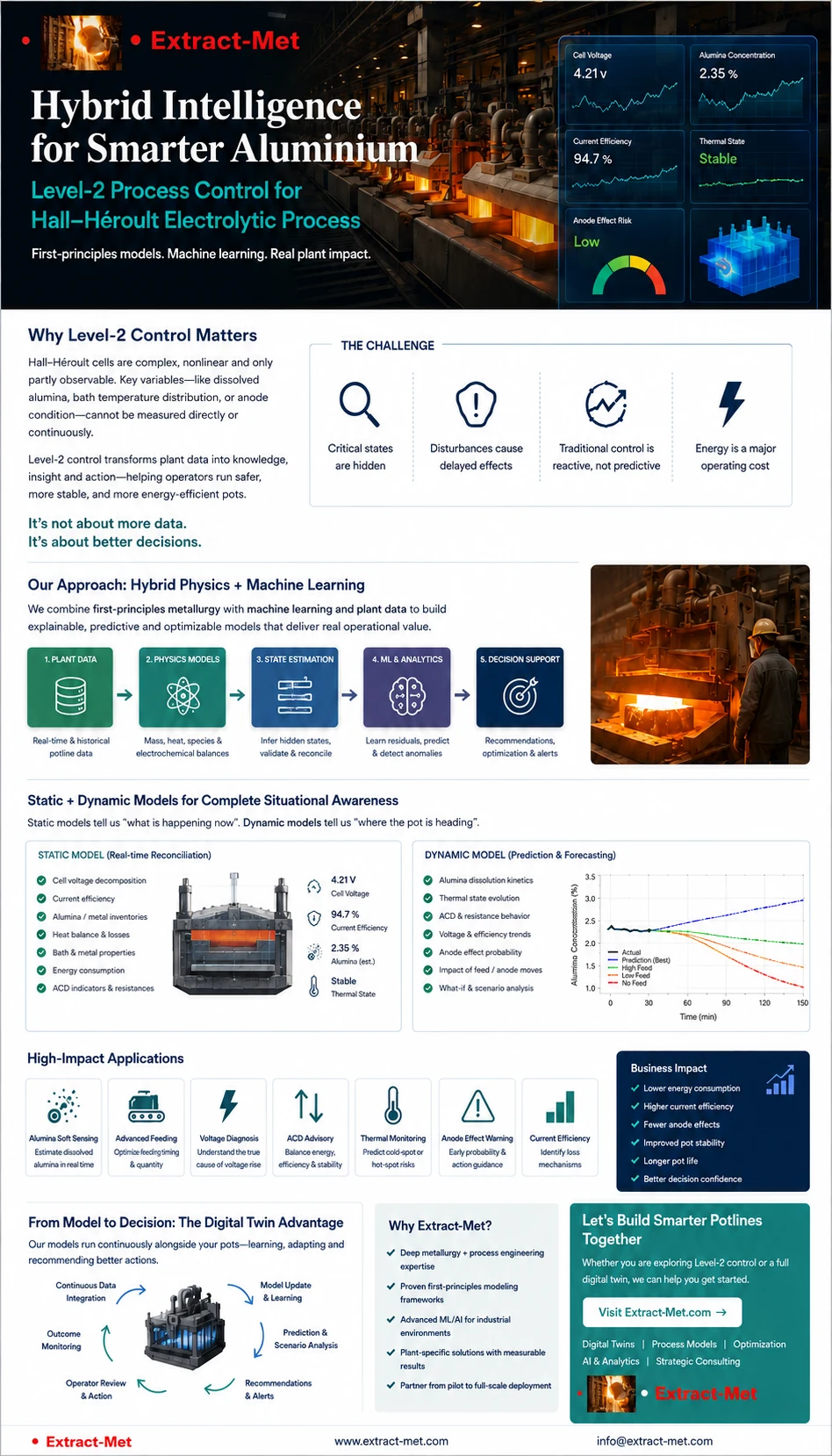
Level‑1 controls equipment. Level‑2 should understand the process.
A useful Level‑2 system does not replace protection logic, interlocks or the basic regulatory control already handled by PLC/DCS systems.
Its job is higher-level process intelligence.
A practical Hall–Héroult Level‑2 architecture can be built around five connected layers.
1. Plant-data acquisition and context
Depending on instrumentation and plant practice, the model can consume:
- pot voltage and line current;
- individual anode-current measurements where available;
- alumina feeder commands and actual feed events;
- beam/anode movements;
- anode changes;
- tapping events and metal quantity;
- bath and metal analytical measurements;
- bath temperature and superheat-related measurements;
- additions such as AlF₃ or other bath adjustments;
- pot alarms and event history;
- ambient and cooling conditions where relevant;
- pot geometry, lining age and design information.
A crucial design principle is to keep event context with the measurements. A voltage excursion immediately after an anode move means something different from an apparently similar excursion during prolonged underfeeding.
2. First-principles process model
The physics layer provides the auditable backbone.
Depending on the required fidelity, it can include:
- Faraday-law aluminium production;
- alumina consumption;
- carbon-anode consumption;
- mass and species balances;
- bath and metal inventories;
- electrochemical voltage terms;
- ohmic resistance;
- ACD-related voltage behaviour;
- gas generation;
- heat generation;
- heat-loss estimation;
- bath-property correlations;
- thermal inventory;
- sideledge/thermal-resistance proxies;
- alumina dissolution and transport models.
This layer answers a fundamental question:
What process state is physically consistent with the measurements we have?
3. State estimation and soft sensors
The real industrial opportunity appears when the model estimates what the plant cannot measure continuously.
Published Hall–Héroult research has demonstrated observer-based estimation of alumina concentration, spatial alumina distribution and ACD-related states. That makes soft sensing a serious engineering route rather than merely a visualization concept.
Candidate soft sensors include:
- dissolved alumina concentration;
- local alumina state;
- ACD/resistance indicators;
- current efficiency;
- thermal-state indicators;
- sideledge-related state;
- abnormal-condition probability;
- pot-health indices.
4. Machine learning and plant adaptation
A first-principles model will never represent every plant-specific effect perfectly.
Anode quality varies. Feeder behaviour changes. Refractory condition evolves. Heat losses drift with lining age. Sensors develop offsets. Pot-to-pot behaviour is never identical.
Machine learning can learn the residual between the physics model and the plant.
Useful ML functions include:
- model-bias correction;
- parameter adaptation;
- anomaly detection;
- sensor validation;
- anode-effect classification;
- pattern recognition;
- pot clustering;
- short-horizon forecasting;
- prediction-confidence estimation.
The key is that ML should complement the physics model—not erase it.
5. Decision support and optimization
The final layer converts estimated state into operating guidance.
Possible functions include:
- alumina-feed advisory;
- ACD/voltage guidance;
- thermal-state guidance;
- anode-effect early warning;
- current-efficiency diagnostics;
- pot-health scoring;
- what-if simulation;
- constrained optimization;
- KPI and exception prioritization.
The operator should see not just what the model recommends, but also why.
Static model: “What is the condition of my pot right now?”
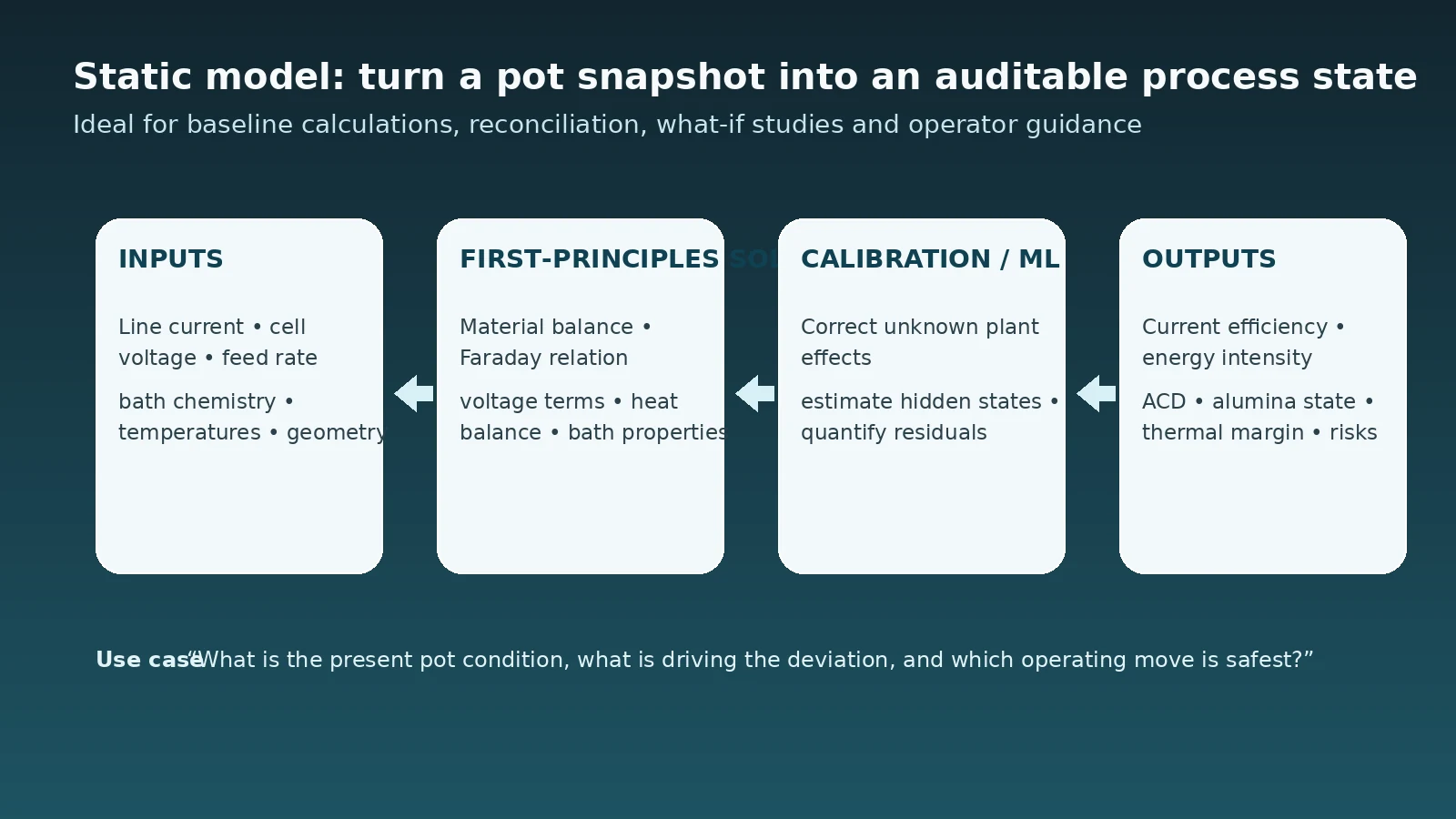
A static first-principles model reconciles the present measurements with physical balances.
It is useful even before real-time deployment because it creates a repeatable engineering calculation that can be checked heat by heat—or pot by pot.
Typical outputs can include:
Production and electrochemistry
- theoretical aluminium production;
- estimated actual production;
- current-efficiency estimate;
- alumina consumption;
- carbon consumption.
Electrical state
- cell-voltage decomposition;
- effective resistance;
- ACD-related indicators;
- estimated voltage losses.
Material state
- bath inventory;
- metal inventory;
- composition-derived bath properties;
- expected gas/carbon balance.
Thermal state
- heat generation;
- heat-loss estimate;
- thermal margin;
- hot/cold tendency;
- sideledge-related proxy variables.
Diagnostics
- measured-versus-calculated residuals;
- sensor inconsistency flags;
- abnormal deviation from pot-specific baseline.
A good static model gives engineers an auditable process snapshot.
It is especially useful for offline studies, historical-data reconciliation, pot benchmarking, operating-window studies, model commissioning and operator training.
Dynamic model: “Where is the pot heading?”
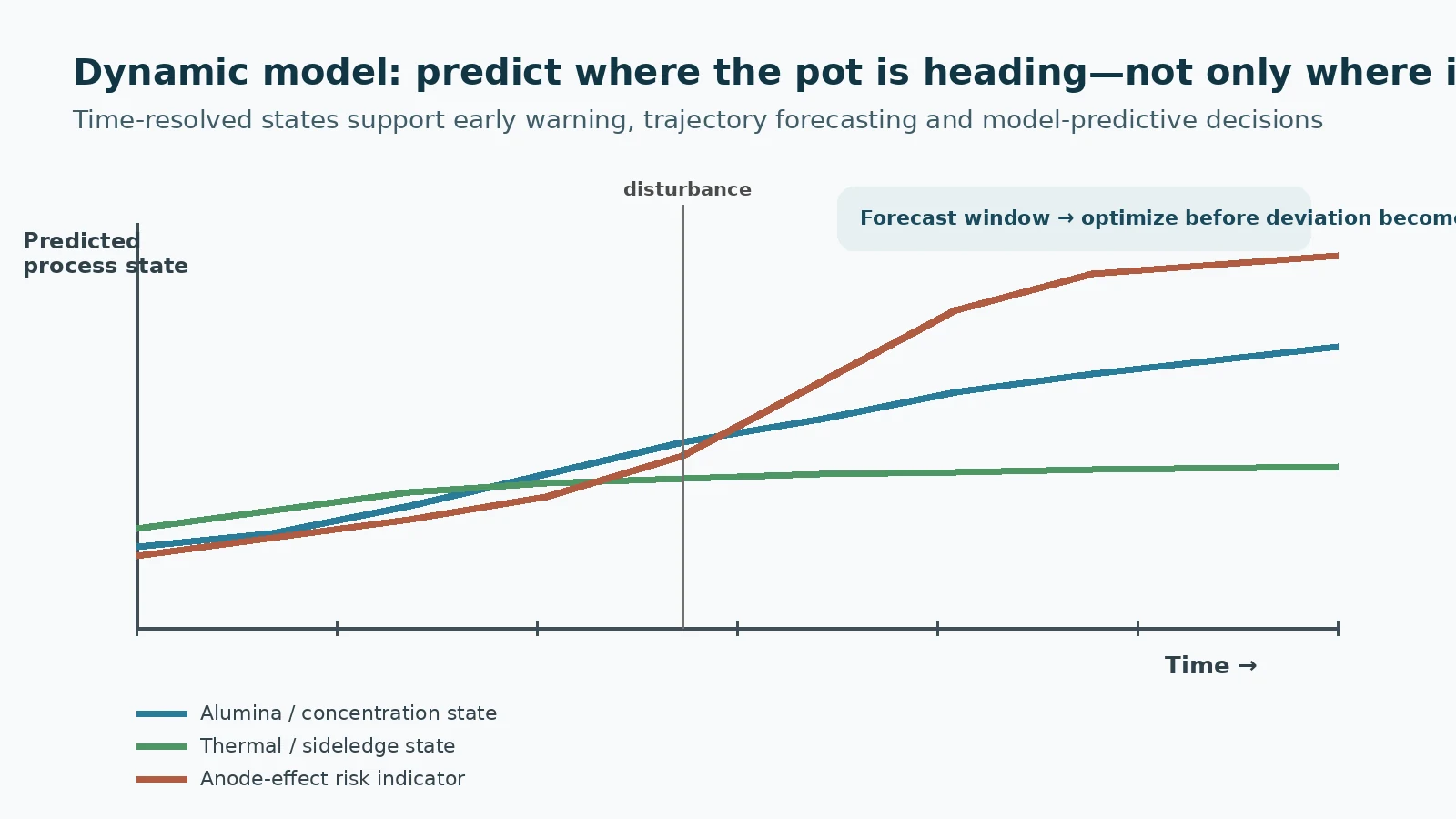
The most valuable operating questions are often forward-looking.
A dynamic model tracks state trajectories through time.
Instead of asking only “what is the alumina concentration now?”, it asks:
- What will the alumina trajectory look like under the present feeding pattern?
- Is thermal inventory drifting toward a cold or hot condition?
- What is the predicted response to an anode movement?
- How does tapping affect metal height, resistance and thermal state?
- Is the recent voltage/time-series pattern consistent with increasing anode-effect risk?
- What is the likely operating state 15, 30 or 60 minutes ahead?
A dynamic Level‑2 model can contain differential or difference equations for:
- dissolved alumina;
- undissolved/alumina-feeding state;
- bath and metal inventory;
- heat inventory;
- resistance/ACD state;
- current efficiency;
- gas generation;
- event-induced disturbances.
This makes the Level‑2 system a trajectory engine, not just a dashboard.
Research has already demonstrated dynamic alumina-concentration models, thermal models and observer structures suitable for Hall–Héroult monitoring and control.
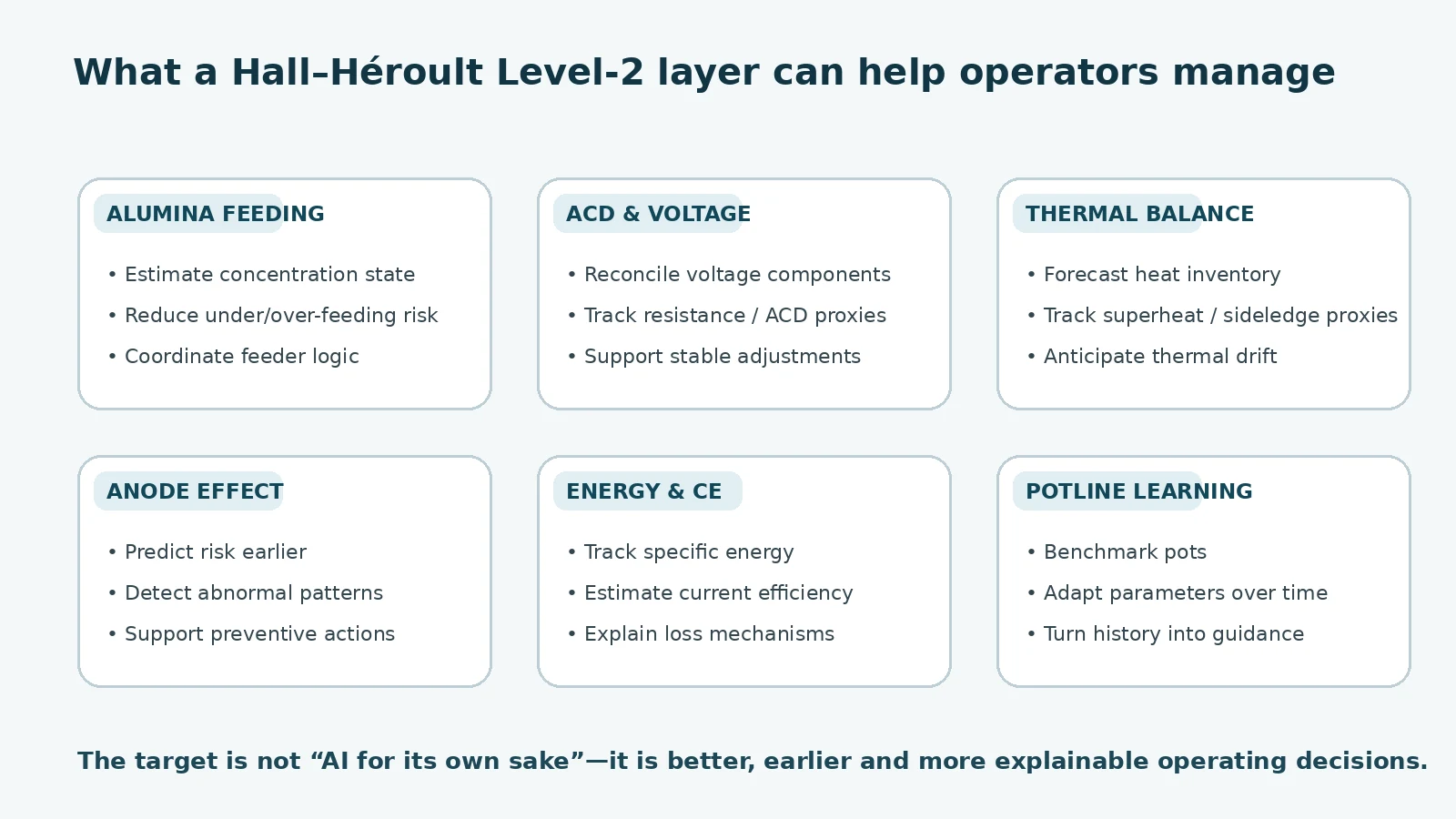
Six high-value applications for an aluminium smelter
1. Alumina soft sensing
Alumina concentration is critical but difficult to measure continuously in a production cell.
A hybrid soft sensor can combine:
- feed history;
- estimated electrochemical consumption;
- voltage/pseudo-resistance behaviour;
- current;
- anode-current information where available;
- dissolution/transport dynamics;
- recent pot events.
The objective is a continuously updated estimated alumina state with confidence limits.
That estimate can then become an input to feeding decisions and anode-effect risk prediction.
2. Advanced alumina feeding
The control problem is not simply “feed more” or “feed less.”
A better Level‑2 question is:
How much alumina is likely dissolved, how much is still available to dissolve, what has been electrochemically consumed, and what feed strategy best returns the cell to its target trajectory?
Published work on advanced monitoring, state estimation and model-predictive control provides a strong technical basis for this direction.
3. Voltage interpretation and ACD advisory
Cell voltage is rich in information but poor in explanation unless it is decomposed.
A Level‑2 model can distinguish among likely contributions from:
- ACD;
- bath/electrolyte resistance;
- electrode terms;
- bubble-related effects;
- thermal/bath-property changes;
- abnormal electrical behaviour.
This is much more useful than displaying total voltage alone.
The output can support ACD advisory decisions while preserving plant-specific limits on stability, pot condition and energy.
4. Thermal-state prediction
The thermal state evolves slowly enough to be predictable but can become costly when deviation is recognized late.
A dynamic heat-balance layer can track:
- heat generation;
- estimated wall/side losses;
- thermal inventory;
- bath temperature trend;
- sideledge/thermal-resistance proxy;
- response to current, ACD and operating events.
The aim is earlier recognition of thermal drift, not merely retrospective alarm.
5. Anode-effect early warning
Anode effects are an obvious target for predictive analytics because the useful action must occur before the event.
Time-series machine-learning work has already demonstrated that recent cell behaviour can contain predictive information.
A robust industrial implementation can combine ML probability with inferred alumina state and process context.
The operator then receives something more useful than a raw classifier score:
Anode-effect risk is rising; the estimated alumina state and recent feeding response are the main contributors.
6. Current-efficiency and energy diagnostics
A continuous current-efficiency estimate can help separate performance loss from simple production variation.
A hybrid diagnostic system can compare:
- theoretical production from current;
- metal output/tapping history;
- inferred current efficiency;
- cell voltage and resistance;
- thermal state;
- recent operating events.
The objective is not to promise a universal percentage improvement.
It is to identify where each plant is losing performance, quantify the opportunity using that plant’s own data, and validate the gain during a pilot.
Why hybrid modelling is stronger than either physics or AI alone
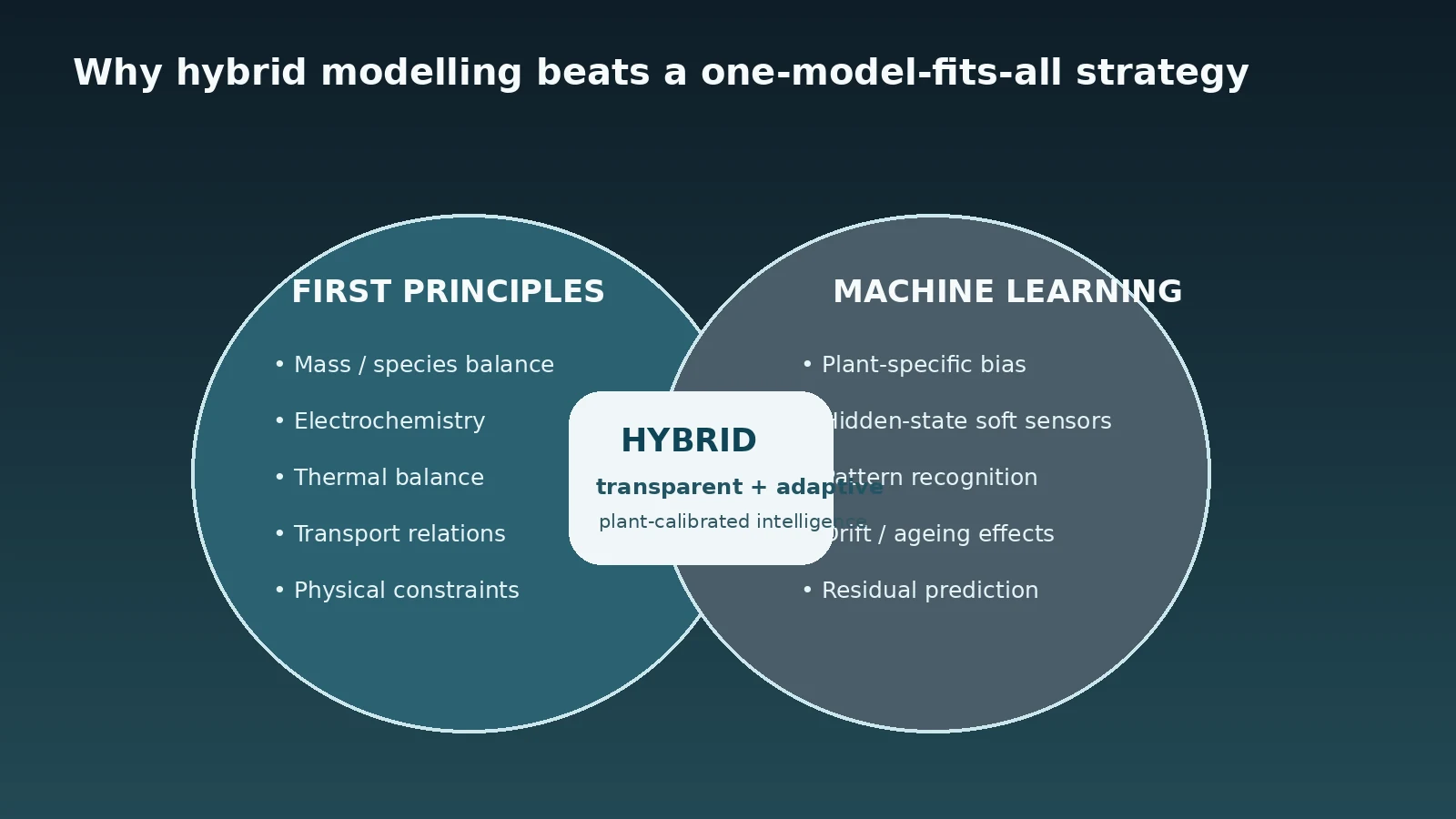
First principles alone
Strengths
- obey conservation laws;
- remain interpretable;
- use metallurgical/electrochemical knowledge;
- extrapolate more safely than unconstrained correlations;
- expose cause-and-effect relationships.
Limitations
- uncertain parameters;
- simplifications in transport and heat loss;
- plant-specific behaviour;
- equipment ageing;
- sensor bias and unmodelled disturbances.
Machine learning alone
Strengths
- identifies complex nonlinear patterns;
- learns plant-specific relationships;
- handles large historian datasets;
- supports classification and forecasting.
Limitations
- can fail outside the training domain;
- may learn spurious correlations;
- may be difficult to explain;
- does not automatically respect conservation laws or physical constraints.
The hybrid answer
A hybrid model can use physics as the structured core and machine learning as the adaptive correction and prediction layer.
This can be implemented in several ways:
- residual ML correction of first-principles predictions;
- ML-assisted parameter estimation;
- state estimators with data-driven corrections;
- physics-informed neural networks;
- ML classifiers driven by physics-derived features;
- constrained optimization using a mechanistic dynamic model.
For industrial adoption, this architecture has another advantage: engineers can challenge the model.
That is essential.
A Level‑2 system should explain its recommendation
Industrial AI needs a higher standard than consumer analytics.
A potroom engineer should be able to ask:
Why are you recommending additional alumina?
Why do you think this voltage rise is ACD-related?
Why has the pot-health score deteriorated?
Why is the thermal-state warning increasing?
The system should answer using interpretable evidence.
For example:
“Estimated dissolved alumina has fallen because modelled electrochemical consumption has exceeded effective dissolved feed during the previous interval. Voltage/pseudo-resistance behaviour is consistent with the inferred decline.”
Or:
“The total voltage increase is larger than the ACD-related component predicted from the beam movement. The remaining residual is inconsistent with the pot’s historical baseline.”
Or:
“Thermal inventory has declined continuously across several operating events; the dynamic model predicts continuation of the cold trend under the present ACD/current condition.”
That is process intelligence.
From one use case to a potline digital twin
Extract‑Met’s broader digital-twin approach starts with first-principles balances and process physics, then adds plant-data reconciliation, soft sensors, prediction and optimization.
For Hall–Héroult smelting, the same staged logic can reduce implementation risk.
Stage 1 — Define one measurable decision problem
Examples:
- reduce anode-effect frequency;
- improve alumina-feed stability;
- estimate current efficiency online;
- improve thermal-state visibility;
- reduce unexplained voltage variability;
- detect abnormal pots earlier.
Define the KPI and baseline before building the model.
Stage 2 — Data audit and process mapping
Review:
- available tags;
- data frequency;
- missing-data patterns;
- measurement quality;
- event coding;
- operating practices;
- pot-design differences.
Stage 3 — Static model and reconciliation
Build the auditable physics base and validate it against representative operating cases.
Stage 4 — Dynamic state model
Add time-dependent states and event handling.
Stage 5 — ML / soft-sensor layer
Train only on reliable data and use cross-validation by time period and, where possible, by pot.
Stage 6 — Shadow-mode deployment
Run against live data without changing plant control.
Compare:
- prediction versus actual;
- risk alert versus actual event;
- recommended action versus operator action;
- model confidence versus error.
Stage 7 — Operator advisory
Expose the model through a focused interface with:
- current state;
- predicted trajectory;
- cause ranking;
- recommended action;
- confidence;
- supporting evidence.
Stage 8 — Closed-loop optimization where justified
Closed-loop integration should happen only after technical validation, cybersecurity review, operating approval and appropriate constraints.
What the Extract‑Met Hall–Héroult Level‑2 package can contain
A plant-specific implementation can be configured from modular components.
Static process model
- Faraday production;
- alumina/carbon balance;
- bath/metal inventory;
- voltage decomposition;
- ACD/resistance;
- thermal balance;
- current efficiency;
- specific-energy KPIs.
Dynamic process model
- feed and alumina-state dynamics;
- heat-inventory evolution;
- resistance/ACD trajectory;
- tapping and anode-change events;
- dynamic production/current-efficiency state;
- disturbance simulation.
Soft sensors and ML
- alumina concentration;
- thermal state;
- current efficiency;
- anode-effect risk;
- anomaly detection;
- pot-health score;
- model drift detection.
Decision support
- feed advisory;
- ACD advisory;
- thermal guidance;
- abnormal-condition warnings;
- pot ranking;
- what-if simulation;
- constrained optimization.
Integration
- historian/database interface;
- PLC/DCS data exchange where permitted;
- engineering dashboard;
- web-based supervisory interface;
- reporting and model-health monitoring.
Explore Extract‑Met’s digital-twin architecture
Visit the Extract‑Met Model Demo Hub
What should a pilot prove?
A strong pilot is not judged by how sophisticated the AI sounds.
It is judged by whether it improves a measurable operating decision.
Depending on the use case, success criteria can include:
- prediction error for alumina-state estimation;
- early-warning precision/recall for anode effects;
- reduction in unexplained cell-voltage excursions;
- better thermal-state prediction;
- tighter current-efficiency estimation;
- fewer false alarms;
- operator acceptance;
- measurable energy/productivity/stability improvement versus a defined baseline.
No generic percentage should be promised before plant validation.
The right approach is to quantify the opportunity using the client’s own operating history, validate the model in shadow mode, then calculate the demonstrated financial impact.
That makes the business case defensible.
Beyond conventional optimization: future-ready control
The same dynamic models used for normal pot operation can also support emerging operating questions.
One example is power modulation.
As electricity systems incorporate more variable renewable generation, aluminium smelters are increasingly interested in how cell current and ACD might be adjusted while respecting thermal and operating constraints.
Recent model-based research has explored Hall–Héroult power-modulation optimization explicitly.
That does not mean every potline should immediately become a flexible electrical load.
It means a validated dynamic model can provide the engineering platform needed to study such strategies safely before implementation.
The real opportunity: give every pot a continuously updated engineering interpretation
A modern smelter already has automation.
It already has historians.
It already has alarms.
It already has skilled operators.
The missing layer is often the one that continuously combines all four with process physics:
What state is this pot really in?
What is changing?
Why is it changing?
What is likely to happen next?
Which action gives the best outcome within safe operating limits?
That is the role of Level‑2 process intelligence.
And that is the direction in which Extract‑Met sees Hall–Héroult control evolving.
Let’s start with one potline problem that matters
If your aluminium smelter is evaluating:
- Hall–Héroult static or dynamic models;
- Level‑2 supervisory control;
- alumina soft sensing;
- advanced feed control;
- ACD/voltage optimization;
- thermal-state prediction;
- current-efficiency estimation;
- anode-effect early warning;
- pot-health analytics;
- physics + ML digital twins;
we can begin with a focused feasibility and historical-data study and build toward shadow-mode deployment.
Discuss a project with Extract‑Met
Physics. Data. Intelligence.
References and Further Technical Reading
1. International Aluminium Institute (2024). *Primary Aluminium Smelting Energy Intensity.* International Aluminium Institute.
https://international-aluminium.org/statistics/primary-aluminium-smelting-energy-intensity/
2. Shi, J. et al. (2021). *A New Control Strategy for the Aluminum Reduction Process Using Economic Model Predictive Control.* IFAC-PapersOnLine.
https://www.sciencedirect.com/science/article/pii/S2405896321014518
3. Wong, C. J. et al. (2021). *Discretized Thermal Model of Hall-Héroult Cells for Monitoring and Control.* IFAC-PapersOnLine, 54(11).
https://www.sciencedirect.com/science/article/pii/S2405896321014543
4. da Silva Moreira, L. J. et al. (2022). *Modeling and observer design for aluminum manufacturing.* European Journal of Control, 64, 100611.
https://www.sciencedirect.com/science/article/abs/pii/S0947358021001400
5. da Silva Moreira, L. J. et al. (2022). *Convection-diffusion Model for Alumina Concentration in Hall-Héroult Cells.* IFAC-PapersOnLine.
https://www.sciencedirect.com/science/article/abs/pii/S240589632201494X
6. Yao, Y. et al. (2017). *Estimation of spatial alumina concentration in an aluminum reduction cell using a multilevel state observer.* AIChE Journal, 63. DOI: 10.1002/aic.15656.
https://aiche.onlinelibrary.wiley.com/doi/10.1002/aic.15656
7. Kremser, R., Grabowski, N., Düssel, R., Mulder, A., & Tutsch, D. (2020). *Anode Effect Prediction in Hall-Héroult Cells Using Time Series Characteristics.* Applied Sciences, 10(24), 9050.
https://www.mdpi.com/2076-3417/10/24/9050
8. Shi, J. et al. (2023). *Advanced Monitoring and Control of Alumina Concentration in Aluminum Reduction Cells.* IFAC-PapersOnLine.
https://www.sciencedirect.com/science/article/pii/S2405896323011138
9. Ma, L. et al. (2024). *H∞ Filter-based Alumina Concentration Estimation for an Aluminum Reduction Cell.* IFAC-PapersOnLine.
https://www.sciencedirect.com/science/article/pii/S2405896324017245
10. Mattioni, A. et al. (2024). *A Local Alumina and ACD Observer for Aluminium Electrolysis Cells Using Anode Currents.* ICSOBA.
https://icsoba.org/assets/files/publications/2024/Shorts/AL16S%20-%20A%20Local%20Alumina%20and%20ACD%20Observer%20for%20Aluminium%20Electrolysis%20Cells%20Using%20Anode%20Currents.pdf
Recommended Medium tags
Aluminium · Process Control · Industrial AI · Digital Twin · Machine Learning
SEO title
Hall–Héroult Level‑2 Control: Hybrid Physics + Machine Learning for Smarter Aluminium Smelting
SEO / social description
A plant-ready framework for Hall–Héroult Level‑2 control combining first-principles electrochemistry, dynamic process models, state estimation and machine learning for alumina feeding, ACD, thermal state, anode-effect prediction and operating optimization.
LinkedIn teaser
A Hall–Héroult pot generates data every second—but several of its most important states remain hidden.
The next step in aluminium-smelting automation is not another dashboard. It is a Level‑2 process-intelligence layer that combines first-principles metallurgy, dynamic state estimation and machine learning to explain the present pot state, predict where it is heading and support the next operating decision.
Read the full Extract‑Met perspective on hybrid Hall–Héroult process control.